Charge Transport Layer Materials, Dopant Materials, Electron Injection Layer Materials


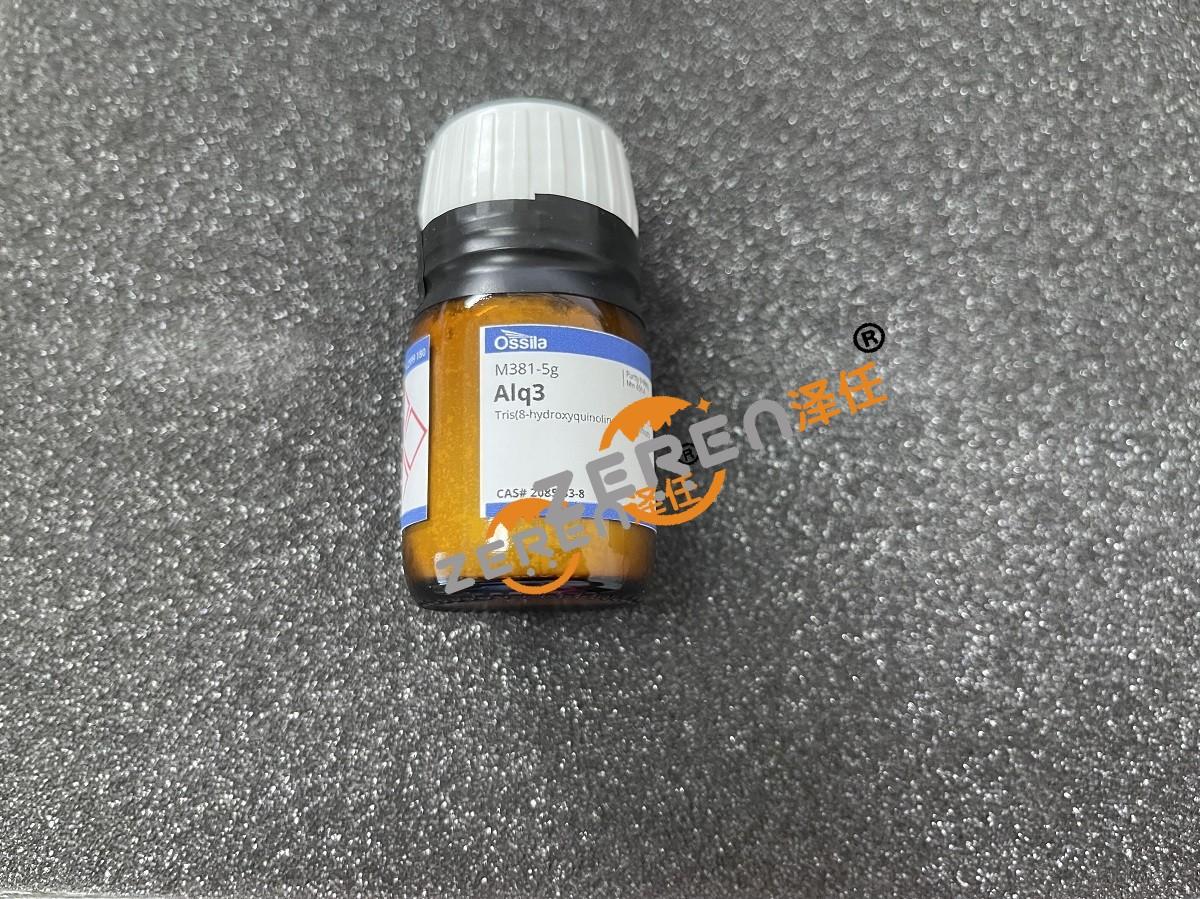
Alq3 as the electron-transport and emitting layer material was the first efficient low molecular weight OLED reported by Tang in 1987 [1]. Since then, metaloquinolates have become the focus of new electroluminescent materials research, with Alq3 being the most studied.
| Full name | Tris(8-hydroxyquinoline)aluminum |
|---|---|
| Synonyms |
|
| CAS number | 2085-33-8 |
| Molecular formula | C27H18AlN3O3 |
| Molecular weight | 459.43 g/mol |
| Absorption | λmax 259 nm (in THF) |
| Fluorescence | λmax 512 nm (in THF) |
| HOMO / LUMO | HOMO 5.62 eV LUMO 2.85 eV |
| Classification / Family | Organometallic, Electron transport layer (ETL), Electron injection layer (EIL), OLED emitting layer (ELM) |
| Purity | >99% (sublimed) |
|---|---|
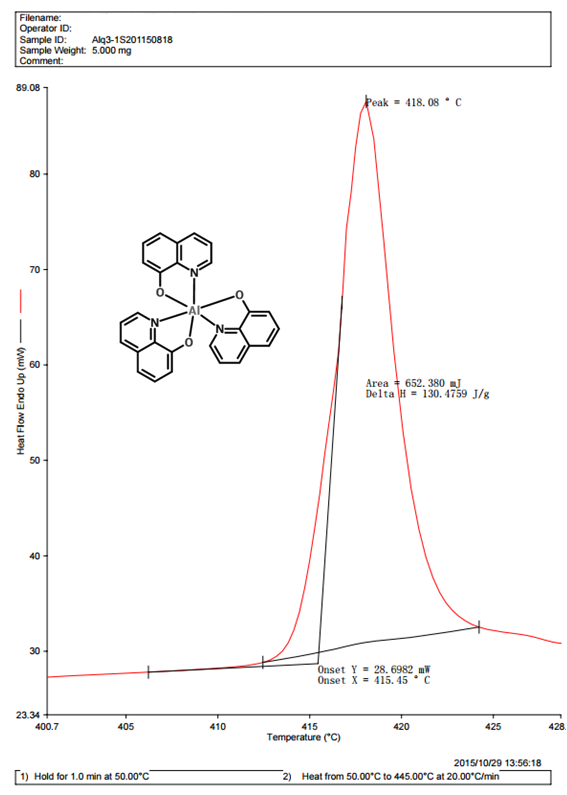
| Melting point | 415.4 °C (DSC onset) |
| Appearance | Yellow-greenish powder |
*Sublimation is a technique used to obtain ultra pure-grade chemicals. For more details about sublimation, please refer to the Sublimed Materials page.
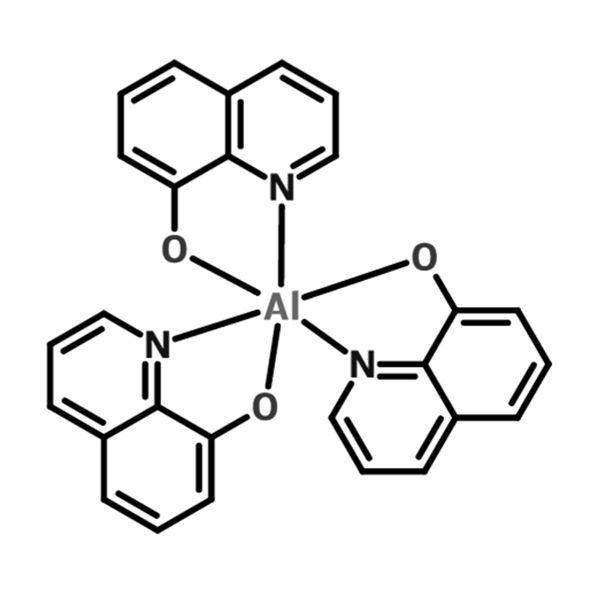 Chemical structure of tris-(8-hydroxyquinoline)aluminum (Alq3)
| Device structure | ITO/ NPB(60 nm)/Alq3:DCM(7nm)/BCP(12 nm)/ Alq3(36nm)/ MgAg(200 nm) [2] |
|---|---|
| Colour |
Red 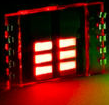
|
| Max. Luminance | 1, 000 cd/m2 |
| Max. Current Efficiency | 5.66 cd/A |
| Device structure | ITO/m-MTDATA:MoOx (3:1, 15 nm)/m-MTDATA (30 nm)/NPB (5 nm)/Alq3 (50 nm)/BPhen (10 nm)/LiF (1 nm)/Al (100 nm) [3] |
|---|---|
| Colour |
Green 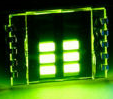
|
| Max. Luminance | 42,090 cd/m2 |
| Max. Current Efficiency | 4.77 cd/A |
| Max. Power Efficiency | 3.5 lm W−1 |
| Device structure | ITO/α-NPD* (50 nm)/7%-Ir(ppy)3:CBP (20 nm)/BCP (10 nm)/Alq3 (40 nm)/Mg–Ag (100 nm)/Ag (20 nm) [4] |
|---|---|
| Colour |
Green
|
| Max EQE | (12.0±0.6)% |
| Max. Powder Efficiency | (45±2) lm W−1 |
| Device structure | ITO/NPB (30 nm)/NPB: DCJTB: C545T* (10 nm)/NPB (4 nm)/DNA (8 nm)/(BCP) (9 nm)/Alq3 (30 nm)/LiF (1 nm)/Al (100 nm) [5] |
|---|---|
| Colour |
White 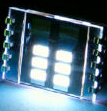
|
| Max. Luminance | 13,600 cd/m2 |
| Max. Current Efficiency | 12.3 cd/A |
| Max. Power Efficiency | 4.4 lm W−1 |
| Device structure | ITO/2-TNATA:33% WO3 (100 nm)/NPB (10 nm)/Alq3 (30 nm)/Bphen (20 nm)/BPhen: 2% Cs (10 nm)/Al (150 nm) [6] |
|---|---|
| Colour |
Green
|
| Operating Voltage for 100 cd/m2 | 3.1 V |
| Current Efficiency for 20 mA/cm2 | 4.4 cd/A |
| Power Efficiency for 20 mA/cm2 | 3.3 lm W−1 |
| Device structure | ITO/CuPc(6.0 nm)/[NPB*(3.8 nm)/CuPc (1.5 nm)]4/NPB (15.0 nm)/Alq3 (60.0 nm)/Mg:Ag/Ag [7] |
|---|---|
| Colour |
Green
|
| Max. Luminance | 15,000 cd/m2 |
| Max. Current Efficiency | 10.8 cd/A |
*For chemical structure information please refer to the cited references.
When fabricating devices, processing and handling materials in a glove box helps maintain their purity and maintain efficiency by avoiding contamination from particulates, moisture, and airborne impurities.
专业代理国外知名镊子品牌
我们将竭诚为你服务
0755-23003036




 粤ICP备14069686号