

mCBP, 3,3′-Di(9H-carbazol-9-yl)-1,1′-biphenyl, is an isomer of CBP, 4,4′-Di(9H-carbazol-9-yl)-1,1′-biphenyl. The meta-linkage in mCBP limits conjugation to the central biphenyl, preventing excimer formation and thus resulting in a higher triplet energy of 2.8 eV.
Like CBP and CDBP, mCBP is widely used in OLED and TADF-OLED devices as a host material for blue, green, orange, and yellow fluorescent and phosphorescent emitters.
With two carbazole units, mCBP is electron-rich and can be used to form exciplexes with electron acceptors (such as POT2T) as blue emitters.
| CAS number | 342638-54-4 |
|---|---|
| Full name | 3,3′-Di(9H-carbazol-9-yl)-1,1′-biphenyl |
| Chemical formula | C36H24N2 |
| Molecular weight | 484.59 g/mol |
| Absorption | λmax 340 nm in toluene |
| Fluorescence | n/a |
| HOMO/LUMO | HOMO = 6.0 eV, LUMO = 2.4 eV [1] |
| Synonyms | n/a |
| Classification / Family | Carbazole derivatives, fluorescent host materials, blue exciplex host materials, sublimed materials, OLED-TADF, Organic electronics. |
* Measurable with an USB spectrometer, see our spectrometer application notes.
| Purity |
Sublimed* >99% (HPLC), Unsublimed >98% (1H NMR) |
|---|---|
| Melting point | n/a |
| Appearance | White crystals/powder |
* Sublimation is a technique used to obtain ultra pure-grade chemicals, see sublimed materials for more sublimed materials.
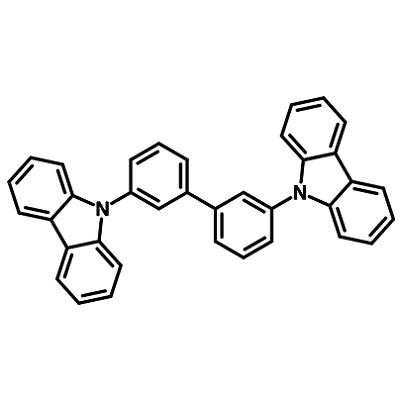 Chemical Structure of mCBP
专业代理国外知名镊子品牌
我们将竭诚为你服务
0755-23003036




 粤ICP备14069686号